Sprinklr Delivers the Feel-Good Factor at Its Unifiers Event
Author

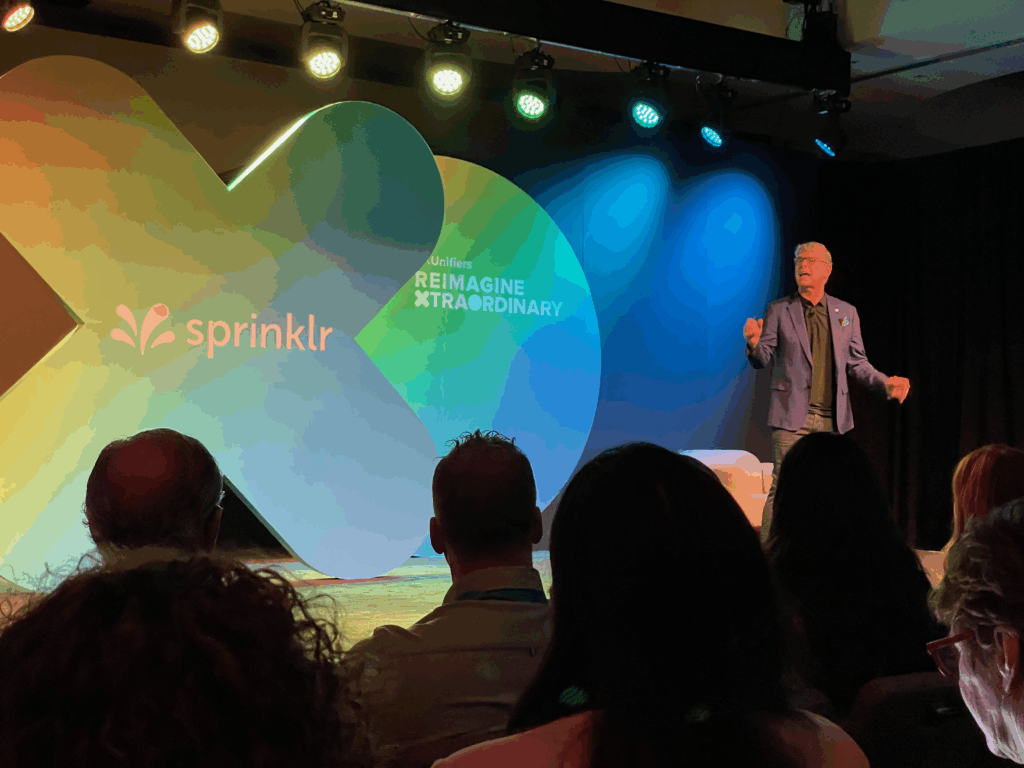
Recently, I attended Sprinklr’s Industry Analyst Event, held alongside its CXUnifiers 2025 customer event in Nashville. It was the perfect mix of time with real-world customers and company execs to inform a renewed perspective of the company since Rory Read has taken the helm as CEO.
Having been in the contact center business for decades, I’ve seen how it’s evolved into the SaaS-powered version we affectionately call CCaaS (Contact Center as a Service). I say affectionately because we’re talking about enabling human to human connection. We may find it quicker and easier to solve problems ourselves but, when needed, hearing a contact center staff member say, “Let’s get to the bottom of this together” feels good. And how good a brand makes us feel at each step of an interaction or based on a lifetime of interactions is what matters most.
Before the main customer keynote, Sprinklr played a brand film that felt refreshing. Most talk about Customer Experience (CX) as if it were a technology. Sprinklr talked about it in more emotive terms like extra care, extra empathy, extra understanding through deeper listening creating better connections. Words like trust and loyalty built on a theme that was about treating people as people. Early on, I found myself thinking that perhaps what separates Sprinklr from the pack is how much further it goes to understand and make customers feel good. It’s roots in social listening and marketing, key to its value, and it being the only comparable CCaaS provider in the Voice of the Customer (VoC) MQ, make this a different kind of CX solution provider.
The Demos Did a Lot of The Talking
Sprinklr positions itself as an AI-native platform for Unified Customer Experience Management (CXM). What that means is, having evolved from social media management (listening, engagement, and publishing) into customer experience management (connecting Marketing, Customer Service, Voice of Customer, and Analytics), it shows how deep insight and intelligence in different types of engagement can deliver on promises of extra empathy, care and understanding.
For example, the real-world end-to-end buying journey I was shown included great customer service interaction capabilities but what stood out was everything that wrapped around it. It incorporated native technology to:
- understand buying intent through smart detection capabilities
- support conversational commerce with a focus on product availability, promotions, and selection advice
- provide an AI-powered sales agent for demonstrations and purchasing assistance
- integrate a white glove buying experience with broad payment support
- capture feedback through a GenAI driven, reasoning powered survey capability.
As enterprises increasingly demand unified views, unified operations, and more automated/AI-driven workflows, Sprinklr’s evolution reflects where the market is going. Sprinklr’s customers seem to agree and hearing directly from them brought the CXM story to life even more clearly.
Real-World Evolution Powered by CXM Thinking
Often at analyst events, we hear from the CEO first, followed by a lineup of executives, and eventually a panel where one or two customers might share their experience. What was wonderful about Sprinklr’s approach was that, aside from our lovely host welcoming us, the first people on stage were customers, one after another, telling their very real stories. This set up the rest of the presentations to be so much more useful. We could ask questions using examples and quotes and context which led to an even more transparent view of what the company is doing, why and how. And even more importantly, it showed how well aligned to buyers Sprinklr is. Each customer talked about Sprinklr differently, providing demonstrable examples of its depth and breadth.
Up first was a well-known entertainment brand whose VP of Customer Intelligence and Experience said, “Less than 5% of our customers generate over 60% of our revenue. So, we had to rethink everything around retaining our most valuable customers.” As the classic contact center evolution example, the company consolidated seven different systems supporting a complete organizational and cultural shift and the onshoring of jobs to “empower skilled, specialized helpers who resolved issues more effectively.” This same presenter said, “The biggest benefit of this partnership is the data. We’re always solving the next most important problem.” He went into considerable detail about laying a digital foundation that more fully leverages Sprinklr’s capabilities. Despite some significant achievements, the company still felt it was catching up to how much Sprinklr could do for it.
One of the most compelling stories came from a major consumer brand with a $150 million distribution business handling more than 9 million deliveries each week. Despite connecting associates, drivers, and customers through a community app built with 150 APIs and 550 microservices, the company was experiencing huge cost inefficiencies and challenges with contact center volumes from drivers, especially. Using Sprinklr’s conversational analytics, sentiment analysis, vertical AI language models, and GenAI-driven root cause insights, the company created an early detection system that’s saving $millions. “Ghost orders,” where drivers arrived for nonexistent or already collected pickups, accounted for about 8% of all contact center calls (around 2,000 a week). After implementing Sprinklr, that number fell to 1.87%, saving the company $4 million a year. Its Voice of the Driver (VoD) initiative continues to cut costs and improve operations. A further $37m of savings have been identified by the platform. This purposeful design of an orchestration engine is a perfect example of how the customer and driver contact is seen as two sides of the same challenge. The contact center is part of a much bigger solution.
A well reputed Social Media industry leader for a major Telco provided some great insights on how Sprinklr had enabled the marketing and customer care team to think as one, also. She touched on social management being a volume game where you have to earn the right to be in people’s feeds and so they could much more narrowly target using Sprinklr. My favorite quote was that they were able to, “move at the speed of culture”. Again, aligning to the Sprinklr keynote opener.
All of the customers that told their story agreed that traditional metrics like handle time don’t compare to real-world measures of problem resolution time. AI-powered operational and engagement intelligence has made Sprinklr indispensable for all of these customers who were great at dealing with a room full of thirsty for detail analysts. And all of them demonstrated how they’d been empowered to ensure engagement with the brand felt good. Those stories set the perfect stage for Rory Read’s keynote, which brought the customer experience philosophy full circle.
The Main Event Highlights
If the customer stories showed what is possible, Read shared his thoughts on why it now matters. He was right to spotlight how every single touch point with a customer is only one moment in a much bigger relationship, and that customers are now judging you on how good those combined moments feel. In fact, customers are even mocking brands based on how bad they are. It seems obvious when you think about it, the relationship I have with my preferred airline isn’t about the last thing I needed them to help me solve it’s about every experience I’ve had with them in chat, in the app and on the phone all as one lifetime experience. And I do have a laugh with friends and colleagues at the company’s expense.
When data from contact center engagement informs marketing in real time, and when marketing sentiment flows back into service, delivering a better experience stops being a department and becomes a shared intelligence responsibility. Joy Corso, Chief Administration Officer for Sprinklr, talked about the “triple infinity loop” and how important it is to reframe marketing, service, and social engagement to be feeding each other continuously. Service hears pain in real time. Marketing sees sentiment in real time. If those signals flow between them, listening, understanding and responding prevents problems, prepares teams, and creates moments that become memorable for all the right reasons. This is what Sprinklr means when it talks about a unified experience and there aren’t many vendors talking about it quite so succinctly. The platform enables brands to remove the emotional whiplash customers feel when engaging with different parts of a business.
Sprinklr claims that AI, data and workflow unification are there to deliver care at scale. Trust at scale. Consistency at scale. If you get that right, you earn loyalty. If you do not, someone else will. That’s where Sprinklr is betting the future lies and its customers tend to agree that this is what’s most valuable to them.
The Human Advantage
Heather McGowan, Future of Work Strategist, closed the main Sprinklr keynote event with what I thought was one of the most thought-provoking sessions of the day. She began with a simple idea: every major human advancement has changed us first, and the world around us second. When humans discovered fire, it didn’t just let us cook food it fundamentally reshaped our biology. Cooked food gave us more energy, shortened our digestive systems, and powered the expansion of our brains. When we invented tools, language, and writing, those innovations didn’t just make us more productive, they rewired how we think, collaborate, and learn. AI, she argued, is the next “fire.” Like every transformative leap before it, it will first change how we think, then how we work, and finally how we organize society. Asking if AI will replace jobs is the wrong question. We should be asking what it will change in how we amplify human capability.
McGowan introduced a striking metaphor of the octopus, a creature that uses coconut shells as mobile shelters instead of growing a hard shell of its own. By staying soft and adaptable, it remains agile in a changing environment. Humans, she said, are at a similar point of decision. We can either harden ourselves in fear of AI by building rigid structures, policies, and hierarchies or we can use AI as the tool that keeps us flexible, creative, and responsive. In terms of the human in the loop thing, she shared a really interesting reference based on the guy known for creating one of the most technically advanced military programs in history, Admiral Hyman Rickover. No matter how complex the system, a human must always be in the loop he insisted. He believed technology could extend our reach but never replace our responsibility. AI can process data faster than we ever could, but it cannot care. That, McGowan reminded us, is still our domain. And it “feels” like this is what Sprinklr is trying to remind us of, too.
Early on Sprinklr lived and breathed the social sciences. Earning the right to be in people’s social feeds by being more relevant, more valuable, and more capable of knowing what people want. It has helped businesses understand the value of thinking this way as it pushes the importance of unified customer experiences.
I believe its AI-native claims carry more weight because the platform has been ingesting and analyzing massive customer datasets for over a decade. It built the foundation for listening, understanding, and engagement long before most competitors even saw it coming.
I can’t help but think this is a vendor who’s not trying to fit into what might be out-of-date market definitions. Sprinklr isn’t generically talking about customer experience, it’s trying to make people feel good about technology again. And in a world driven by data, that might be the most human differentiator of all.


